


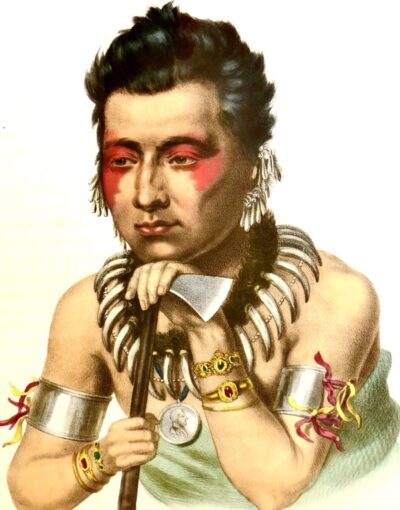


This is an authentic hand colored lithograph by McKenny Hall and originally painted in the 1820’s by Charles King” of YOUNG MAH–HAS–KAH” (born 1784–1834), also known as “Chief White Cloud” who was a member of the Loway Tribe. He was the son of “MAHASKA THE ELDER” who was killed in 1823. The Loway people were indigeneous to the state of Iowa from which it’s namesake is derived. They started out in the Great Lakes region as the Oniota people; later migrating to the Iowa region for better agriculture and forced migration by the federal government. In 1837 they were again pressured to relocate to Oklahoma, where their descendants live today. The spouse of MAHASKA” was “RANTCHEWAIME” also known as flying Pigeon” and she was also memorialized by McKenny and Hall. “MAHASKA” eventually assimilated to the ‘white man’s ways becoming a farmer, and because of that he was murdered (shot in the back) by one of his Indian Sioux foes in 1834.
The subject matter “MAHASKA” proudly rests his head on his hand while clutching a tomahawk. He is hand colored with a green tunic with flesh tones to his body and face, and red facial paint accents.
This example is quite rare and seldom is offered for sale. It is beautifully and professionally mounted and preserved in a lovely contemporary bird’s eye maple frame with a double matte and archival backing. The colors are bright and strong with very little exposure to the elements and maintain a UV plexiglass front. It is a full 14″ x 20″ sheet in completely all original condition with no tears, or restoration of any kind; no fading and no touch up. The documentation on the underneath declares the name of the chief, in addition to the genesis;
“YOUNG MA-HAS-KAH”
“CHIEF OF THE IOWAYS”
“Philadelphia Published by E.C. Biddle”
“Entered according to Act of Congress in the year 1837 bt E.C. Biddle in clerks office of the District Court of the Eastern District of Pa”
Whether pursuing the accumulation of multiple McKenney and Hall lithographs or simply wanting a stand alone piece, this is simply a wonderful work of art to add to a collection of Americana or Native American Indians, in addition to having meaningful historical importance.
Dimensions:
27″ high x 23 1/4″ wide x 1 1/4″ deep (overall with frame–frame has
a 2 3/4″ border)
21 1/2″ high x 18″ wide (exposure in frame)
15 1/2″ high x 11 7/8″ wide (actual image exposed in matte).
20″ high x 14″ wide approx (actual folio)
Frame:
Beautifully “figured grain” bird’s eye maple solid wood frame; professionally mounted with archival consideration and backing; UV plexiglass to the front; nice touch with double matte.
Provenance: From my own personal collection of 19th century Native American Indian Western Americana and fine art.
Note: Please see other McKenney & Hall hand painted lithographs I have for sale.
Background:
Thomas McKenney had been appointed superintendent of Indian Trade and had conceived the idea of traveling the western United States to document America’s Native American Indian Tribes. Along with Catlin’s “North American Indian Portfolio”, these are the two most important works of 19th century North American Indian study. McKenney’s work was based on his travel of the west in the late 1820’s. Thomas Hall was the “academia” member of the team who joined later upon McKenney’s return. Charles Bird King painted the Indian portraits, which hung in the Indian Gallery of the War Department. One by one the chiefs and other Indians were brought in to sit for portraits. Other portraits were loosely based on another “in the field” painter who had traveled with McKenney, named J.O. Lewis. The book with the folios and hand-painted lithographs was done in 1836. The significance of this is, that following the transfer of the paintings to the Smithsonian, all of the paintings were destroyed in a fire in 1865. So all we have to chronicle those images are these McKenney-Hall lithographs.
Three publishers were used to complete the three volumes between 1836–1844
1) Edward C. Biddle published the first part in 1836
2) Frederick W. Greenough published subsequent parts in 1838 and into the 1940’s
3) Daniel Rice & James G. Clark continued the project and completed the three volumes between 1842 and 1844
Any complete versions of McKenney’s folio work are very rare and exist in a few private collections, museums, the Smithsonian etc. There are very few complete versions and most of the lithographs have been removed for framing to display, as was this one. This is an authentic and original first edition dated 1837 from the “History of The Indian Tribes of North America” by McKenney and Hall.
Note: I am a second generation antiques dealer and have been in business, buying, selling, and collecting, for 50 years; I am also a member of several prestigious antique associations. Thus, I am well qualified to inspect and evaluate the products I offer for sale and I guarantee this to be authentic and as I have described.