
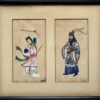
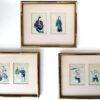


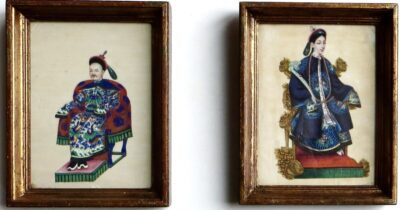
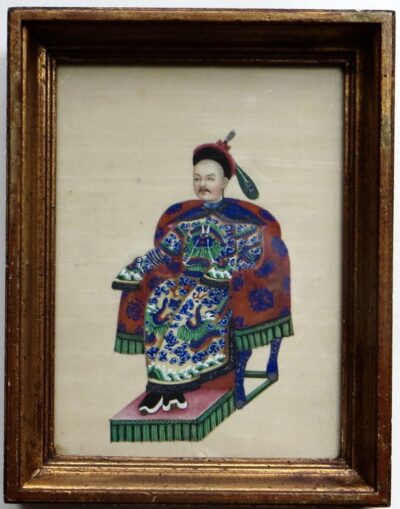
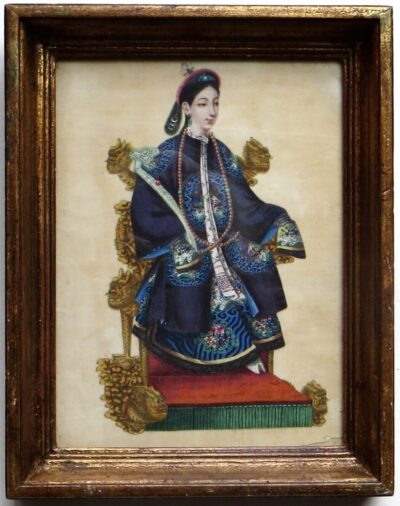
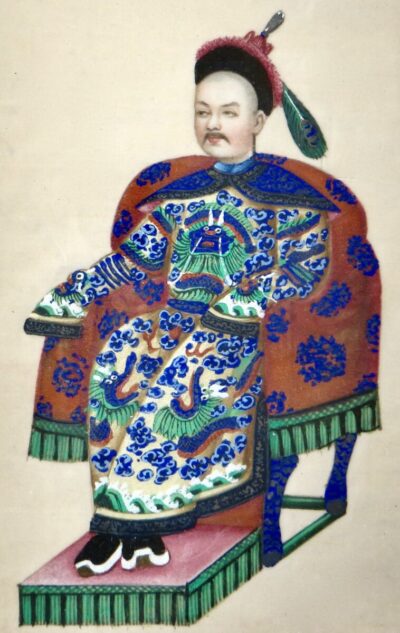
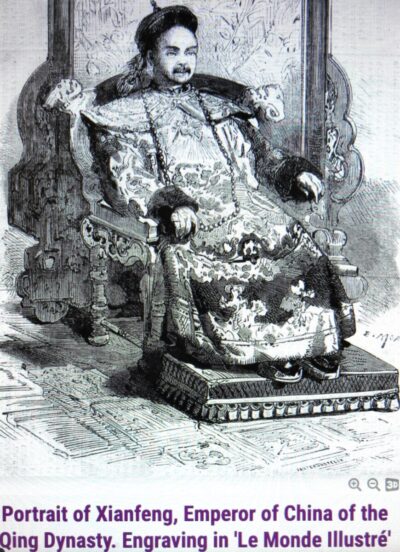
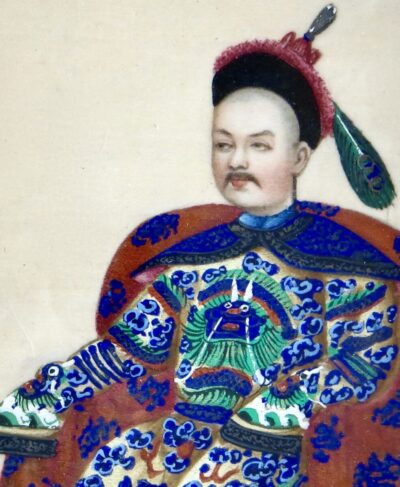
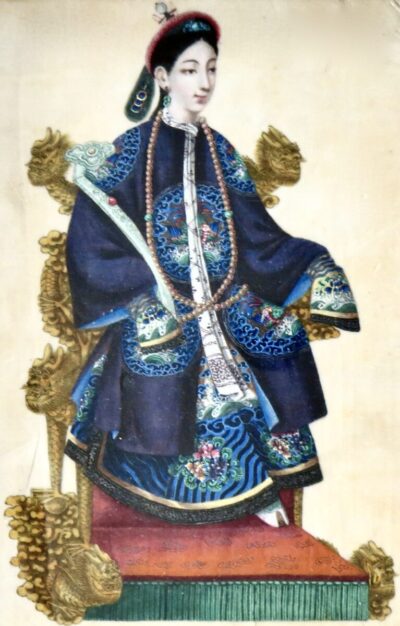
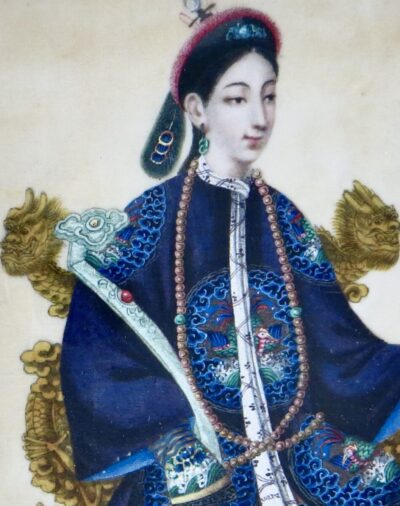
Fabulous pair of mid 19th century Qing Dynasty hand painted watercolor Chinese Pith paintings; subjects attributed to Emperor Xianfeng and Consort Qing. Emperor Xianfeng was the 8th emperor who ruled from 1850- 1861 and there are images extant with similar likeness, attire, and moustache; (see the “likeness” image I have enclosed with the listing); he died in 1861. Consort Qing, a concubine, was his third wife whom he married in 1855 and given the title “Noble Lady”; she died in 1885. Because of the multiplicity of wives, empresses, and concubines, it is difficult to pinpoint the exact “companion”, but the date and likeness most closely resemble Lady Qing. Tourists buying these paintings would have been curious about the leadership and ruling class of China, thus the Imperial subject matter of these paintings.
The paintings exemplify great detail and crisp bright colors In addition to the seated Emperor’s multi colored green, blue and white robe, a red and blue decorated cape is draped over his shoulders.. His headdress is blue and orange with a green plume. His feet are resting on a highly detailed plumb and green platform.
Lady Qing is in even more elaborate attire with a deep green, white and floral dress and a deep rich blue Hanfu; she is seated on an elaborate gold throne with a green and red platform. Her beauty is depicted with a lifelike pleasant smile and features. Both paintings are in a matching pair of 19th century period gilt frames; with the actual painting encompassing the entire surface of the interior borders. There is absolutely no touch up or restoration of any king and both are in all original condition—a wonderful pair of Pith painting examples. Pith paintings are fairly rare, as they are delicate pictures on fragile “Pith” paper.
Dimensions:
(each) 9 3/8″ high x 7 1/4″ wide
7 3/4″ high x 5 5/8″ wide (actual painting under glass)
Note: Please see my other 19th century Chinese Pith Paintings that I have listed for sale.
Background:
19th century Chinese “Pith Paintings” were produced by local Chinese artists; painted predominately in watercolor on sheets of “pith paper” hand cut and trimmed from the stem of a papyrus type plant (indigenous to China), often mistakenly referenced as rice paper. Actual pith paper is porous and spongy, which results in the paint sitting on the surface, and producing a crisp and velvety look, with strong and vibrant sharp colors, often appearing as three dimensional.
During the 1800’s in cities like Canton, China, and other tourist attractions, Chinese artisans painted and sold these gems to travelers as souvenirs to give them a glimpse of life in the “Orient” at the time. Whether it be their dress, customs, mores, or dining habits, Chinese tradition was featured on these small paintings and often they were placed in an inexpensive frame for the long journey home by land and sea. They were very rarely signed. The “heyday” of pith paintings was from the 1830’s to 1870’s (albeit, some earlier examples, circa 1820’s, have been noted). The advent of photography in the late 1800’s resulted in their demise. These mementoes turn up mainly in England, Western Europe, and to some extent, the United States; wealthy Americans having ventured to China in the mid to late 19th century.
Today, Chinese Pith Paintings have universally become quite collectible by antique aficionados and also, for those who like historical 19th century contemporaneous Asian artifacts. Collections can be found and viewed in the British Museum, The Hermitage, and The Peabody/ Essex Museum in Massachusetts.
Note: I am a second generation antiques dealer and have been in business, buying, selling, and collecting, for 50 years; I am also a member of several prestigious antique associations. Thus, I am well qualified to inspect and evaluate the products I offer for sale and I guarantee this to be authentic and as I have described.